Our search
Finding the Land
A place where individual homesteads and shared life can grow side by side.
Living Land is still in its beginning stages. No land has been selected or purchased.
Right now, we are gathering people, listening to what matters, learning about the land, and beginning to define what a community of homesteads could look like in Central California.
The hope is not to build one shared household or ask everyone to live in the same way. The vision is a larger piece of land where individuals and families can create their own homesteads while also sharing certain resources, responsibilities, knowledge, and forms of care.
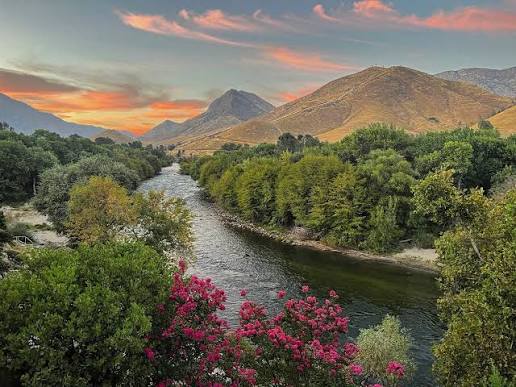
A river valley at sunset in Central California
Where we are looking
Our Working Search Area
We are beginning within roughly 100 miles of Bakersfield, with particular interest in the Kern River Valley, the Lake Isabella area, and other parts of Central California where land, water, community, and long-term resilience may come together.
The search area is intentionally flexible. We want to remain open to the right land rather than become attached to one location too early.
Land criteria
What We Are Looking For
Enough Land to Breathe
Approximately 10 to 20 acres or more, depending on the land, zoning, water, cost, and number of participating households.
The property should offer enough room for private homestead areas as well as shared spaces, food production, animals, water storage, workshops, gathering, and future needs.
A Reliable and Legally Verified Water Source
Water is one of the most important considerations in the search.
We will look carefully at wells, groundwater conditions, water quality, storage capacity, seasonal reliability, drought conditions, and any documented surface water rights.
Being near a river, creek, spring, or lake does not automatically create a legal right to use that water. Any claimed water source or water right will need to be independently verified before a property is considered viable.
Land That Can Support Life
We are looking for usable soil, adequate sunlight, reasonable slopes, places for growing food, and enough ecological health to support long-term stewardship.
Not every part of the property needs to be farmable. Wild spaces, native habitat, trees, rocky areas, and waterways may be equally important parts of the land.
A Legal Path for Multiple Homesteads
Zoning and land-use rules must allow, or offer a realistic path toward, the kind of community being imagined.
Before purchasing land, we will need to understand how many homes or dwellings may legally be placed on the property, whether the land can be divided or held in another shared structure, what is permitted for animals, gardens, orchards, barns, workshops, and agricultural use, what requirements apply to wells, septic systems, roads, fire access, and utilities, and whether any easements, restrictions, mineral rights, or covenants affect the land.
Resilience Without Isolation
The land should allow for greater self-reliance while still remaining accessible to nearby towns, medical care, supplies, schools, work, and emergency services.
We will also consider road access, wildfire exposure, evacuation routes, flood risk, extreme heat, winter weather, insurance availability, and the practical cost of maintaining the property.
Room for People Who May Come Later
Part of the vision is to plan beyond the founding group.
The land may eventually include a small number of guest spaces, temporary accommodations, or reserved areas for family members and trusted people who may need or choose to come later.
The purpose would be to prepare with care, not to promise unlimited access or create an obligation the community cannot sustain.
Possibilities, not a plan
How the Land Might Be Organized
Although the final design will depend on the property and the people involved, the current vision includes:
- Individual homestead areas with meaningful privacy
- Space for homes, gardens, animals, and personal ways of life
- Shared growing areas, orchards, tools, equipment, or workshops
- Common gathering space
- Water storage and practical emergency preparation
- Protected natural areas and wildlife habitat
- Thoughtfully planned guest or temporary-use space
- Clear agreements about care, responsibility, decision-making, and use of shared resources
The ownership and legal structure have not yet been decided. Those decisions should be made carefully, with professional guidance and meaningful participation from the people who become part of the founding process.
A direction, not a guarantee
A Working Timeline
Fall and Winter 2026
Gather and Listen
Begin bringing interested people into conversation. Learn what each person hopes for, what they can contribute, what concerns they carry, and whether there is enough shared ground to continue.
Winter and Spring 2027
Shape the Foundation
Develop clearer community principles, participation expectations, land criteria, financial boundaries, decision-making processes, and possible legal structures.
Spring Through Fall 2027
Explore the Region
Study communities and properties throughout the search area. Visit land, speak with local residents and professionals, and begin developing a realistic understanding of cost, water, zoning, fire, access, and infrastructure.
When a Promising Property Is Found
Slow Down and Investigate
Complete professional due diligence before making any commitment. This may include title review, surveys, zoning confirmation, water-right research, well testing, water-quality testing, soil evaluation, septic feasibility, wildfire and flood review, insurance estimates, and legal and financial consultation.
After the Land Is Secured
Develop in Phases
Begin with essential access, water, sanitation, safety, and shared infrastructure. Homes, gardens, animal areas, workshops, and community spaces would develop gradually according to an agreed plan and the real capacity of the people involved.
This is a direction, not a guaranteed schedule. We will move carefully enough to protect the people, relationships, resources, and land involved.
Join the search
Help Us Look
You do not need to be ready to purchase land to be part of the conversation.
You may have local knowledge, experience with growing food, construction, water, animals, preparedness, land stewardship, cooperative structures, or simply a sincere interest in learning alongside others.
If this vision speaks to you, we would be glad to hear from you.
Important Note
Living Land is an emerging community vision and educational project. It is not currently offering land, housing, membership, investment opportunities, ownership interests, emergency shelter, or financial returns.
All land criteria and timelines are preliminary and may change as the community develops and qualified legal, financial, environmental, water, and land-use professionals are consulted. Expressions of interest do not create membership, ownership, residency, financial, or access rights.